
BARRIER & CONTAINMENT OPTIONS
FIBC Liners for Moisture, Oxygen and Electrostatic Control
Bulk bag liner options reviewed as part of the complete FIBC system—from product compatibility and barrier targets to fit, filling, discharge and static behaviour.
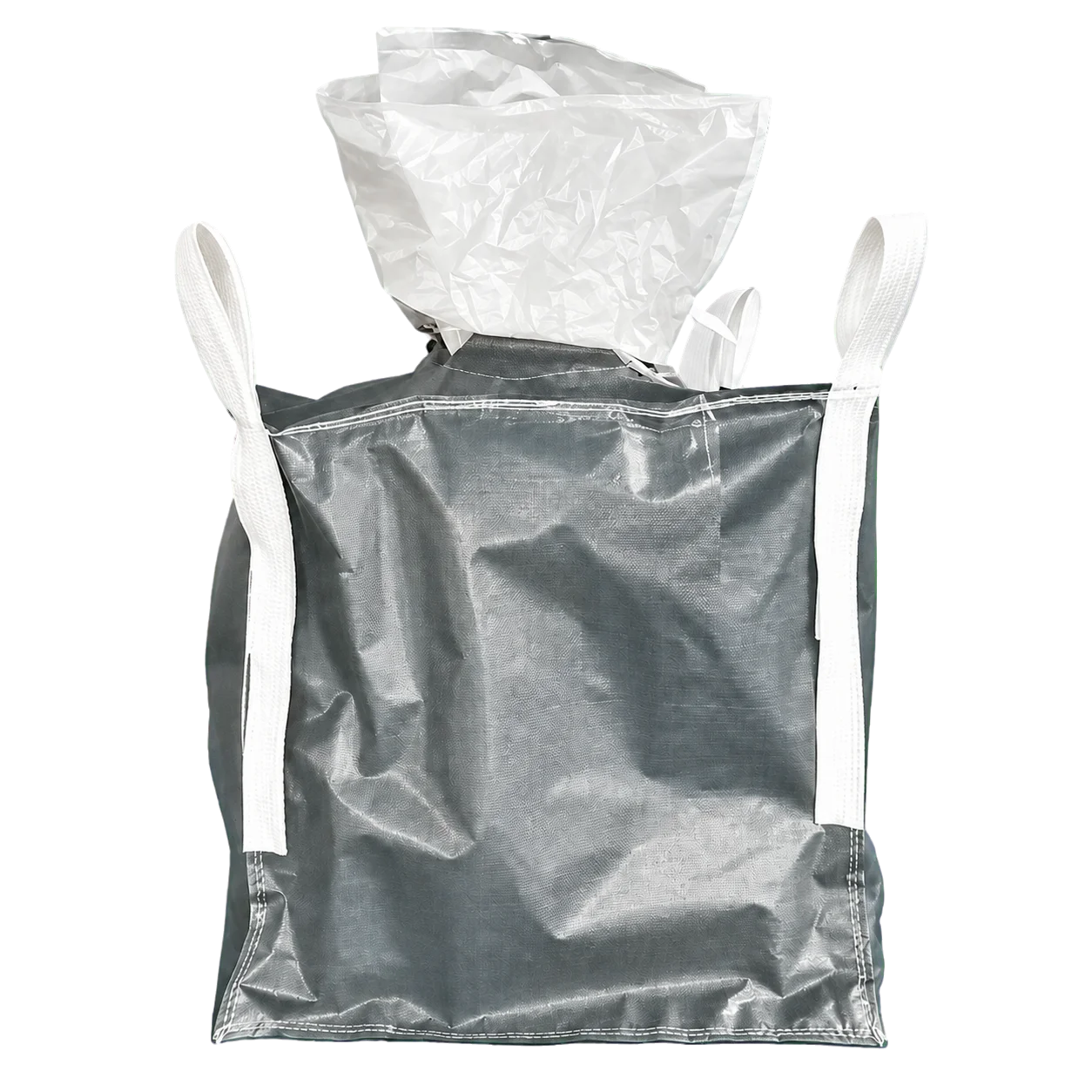
Representative lined FIBC — liner material, fit and performance are defined for each application.
Barrier Target
Moisture and oxygen requirements are specified before film selection.
Compatibility
Product contact, temperature and process chemicals are reviewed.
Controlled Fit
Loose, attached or form-fit concepts depend on equipment and handling.
Static Interaction
Liner and FIBC electrostatic behaviour must be assessed together.
DECISION FRAMEWORK
A liner is a functional component—not an automatic upgrade
The liner must protect the powder without creating new filling, discharge or electrostatic problems. Barrier performance, seal integrity, fit, film stiffness and product compatibility should be specified together with the outer FIBC.
Suitable when
Powders with defined moisture, oxygen, odour, dust-containment or product-contact requirements.
Filling and discharge systems that can be reviewed for liner fit and movement.
Applications with a measurable barrier target or qualification test method.
Do not proceed without review when
Selecting film only by thickness without a barrier or compatibility target.
Treating one sample test result as a guarantee for every liner material and construction.
Using an unreviewed insulating liner in an electrostatic-risk application.
CONFIGURATION
Define the construction around the process
These are engineering inputs, not fixed catalogue promises. Final values are recorded in the approved specification.
01
Barrier construction
Film family, layer structure, thickness, seal concept and target transmission rate can be defined for the application.
02
Fit and retention
Loose, tabbed, glued, tied or form-fit arrangements may be considered subject to the bag and equipment design.
03
Openings and discharge
Inlet, outlet, neck, seal and anti-collapse details are coordinated with filling and emptying equipment.
Available supporting evidence
A third-party sample report includes oxygen- and water-vapour-transmission results for one submitted liner sample. The figures are sample- and test-condition-specific and are not published as a blanket product guarantee.
For quotation, state the target barrier performance, test method, storage duration, climate, product compatibility and acceptable sealing method.
Choose the liner from the failure mode
Start with what must be prevented: moisture gain, oxidation, product loss, foreign matter, dust escape, liner collapse or electrostatic risk. The film and fit follow that priority.
BUYER FAQ
Questions to resolve before quotation
A strong RFQ gives procurement, quality, EHS and operations the same technical starting point.
What is a form-fit liner?
It is shaped to follow the FIBC geometry more closely than a simple tubular liner, helping control folds and fit. Availability depends on the required construction.
Does thicker film always mean better barrier?
No. Barrier depends on polymer and layer structure, not thickness alone.
Can a liner be conductive?
Conductive or dissipative liner concepts exist, but their use must be evaluated with the complete FIBC and grounding strategy.
Can you guarantee oxygen or moisture transmission?
Only for a defined material and test method. Sample data cannot be generalized to every liner.
NEXT STEP
Turn the application into a reviewable specification
Send the material, risk, equipment, load, dimensions, destination and annual demand. We will respond with the missing technical questions before quoting.